Featured work

Projects where AI meets actual problems.

A few things I’ve built, trained, tested, and deployed reframed through the lens I care about most: what problem does this solve, how does it work, and how could it become a useful product?

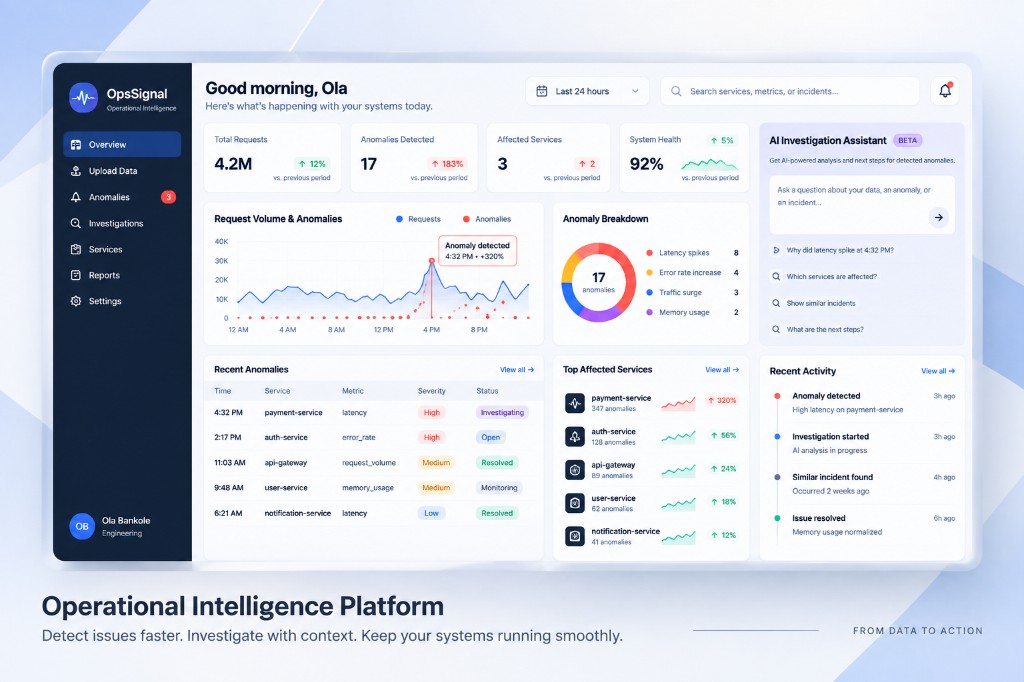
Time-Series Anomaly Detection API

🚨 AI Operations / Anomaly Detection

Time-Series Anomaly Detection API

Problem: Operational teams need earlier warning signs when behavior starts looking unusual.

I built a deployed anomaly detection API that identifies unusual time-series behavior using rolling statistical features, Isolation Forest, FastAPI, Docker, and live API documentation.

Product takeaway: This shows how a model can move beyond a notebook into a usable product workflow that helps teams catch issues before they become expensive.

Python FastAPI Docker Isolation Forest
Skin Cancer Survival Prediction

🩺 AI / Healthcare

Multi-Modal Survival Prediction for Skin Cancer

Problem: Healthcare prediction is only useful when the model is understandable, not just accurate.

I built survival prediction models using clinical, genomic, and imaging data, combining survival modelling, deep learning approaches, and SHAP-based explainability.

Product takeaway: In healthcare AI, trust matters. This project helped me think about explainability, model risk, and how predictions could support decision-making without replacing judgment.

Survival Analysis Deep Learning SHAP Healthcare AI
Emergency Vehicle Classification

🚑 Computer Vision

Emergency Vehicle Image Classification

Problem: Visual classification can help teams identify critical objects faster in high-volume environments.

I trained a CNN-based image classification model to distinguish emergency and non-emergency vehicles, with a focus on model performance, evaluation, and practical use cases.

Product takeaway: This project connects computer vision to operational decision-making: not just “can the model classify?”, but “where could this reduce response time or manual review?”

Computer Vision CNN Image Classification Model Evaluation
Disaster Tweet Classification

🌍 NLP / Crisis Intelligence

Disaster Tweet Classification

Problem: During emergencies, important signals can get buried inside noisy real-time text.

I built an NLP classification pipeline for identifying disaster-related tweets using deep learning models including BiLSTM and GRU.

Product takeaway: This project made me think about AI as a triage layer: helping teams surface urgent signals faster when every minute and every message matters.

NLP BiLSTM GRU Text Classification
3D contact envelope illustration

Contact me

If you’re interested in working together, don’t be a stranger.

Say hi!